
Accepts payment in kibble and / or bone.


 The one with trees is the Gothic Cathedral. The tall spires and the lightness of the façade are a relatively recent addition (19th century) masking the short and squat style typical of medieval Catalan Gothic (Think Santa Maria del Pi and thanks CalderEagle for pointing that out).


 Other differences include the trees. What I've been told are sycamores, but also known as planes, are the dominant ones found shading Barcelona's streets while in Sevilla its the orange tree that gives the city its sweet smell and whose fruit make English marmalade.
 But over time I realized: whereas in the states I went to massive stores like Staples for stationary, Home Depot for hardware and Costco for my shopping, where the employees worked in shifts to provide maximum service; in Spain it was the small family run papeleria two doors down for pens and notebooks, the ferretería a block away for a hammer or screwdriver and the el mercado down the street for my groceries. Most of them were run by a couple with maybe their kids pitching in, which made two in the afternoon time for a family lunch and the weekends a necessary break from their jobs.
  Meanwhile in Barcelona, shopping began in the morning with the smell of baked pastries and bread in the air. Taking carrito with me, I'd step outside and start the day with a coffee at a local bar before heading to the panadería for my freshly baked bread and croissants. Next I'd walk to the local market that was full of stands that specialized in different foods. There were multiple carnicerías for different cuts of meat, charcuterías for the many Spanish hams and cheeses, fruterías for fresh fruits and vegetables and pescaderías for just caught fish and seafood. Each person shopping seemed to have their favorite one, as did I, and when my number was called, I'd step to the counter and receive a warm hello that would lead to a conversation about our families and the weather as the couple working tended to my needs, knowing what I liked and didn't like. Then when the carrito was full with enough food to get me through the next few days, I'd head to the market bar for a small beer and a sandwich before returning home.
 This little bronze man you see is the only statue known to exist of Barcelona's most famous architect - Antoni Gaudi.
  The builder of the Sagrada Familia, Parc Guell and the Casa Batlló, his name is synonymous with the modernist period that makes the city's buildings seem more a fantasy than a reality. Tucked away in a remote neighborhood called Sarria, I had no idea it even existed until last Friday. Same goes for this dragon gate of his:

 Plus, the most comfortable bench I'd ever sat on:
 Of course the beach in Barcelona, and in Spain in general, doesn't only involve tanning and swimming, but also time spent at one of the country's greatest inventions - el chiringuito, which are the small bars you´ll find along almost all Spanish beaches. The perfect spot to cool off and whet the whistle with cold beer, sangria or tinto de verano (red wine with either 7-up, Orange Fanta or lemonade) after roasting in the hot sun, many also serve traditional Spanish dishes like paella and tapas, in addition to such standards as sandwhiches and salads. They aren't cheap by any stretch of the imagination, but that's the price one pays to sit outside in the shade and listen to the waves.
 Stepping outside to a partly sunny afternoon, my ears perked at the sounds of brass and wind instruments floating in the breeze, and it didn't take me long to find out that they belonged to a band playing the music for the traditional Catalan dance called Sardana. Taking a moment to watch, I was struck how different seniors are in Spain compared to the states. Here, they are dancing and laughing, while most I know back home rarely leave the house, and seem to be counting down the days. It's really quite sad when you think about it.


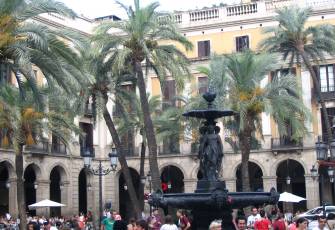 El Barrio Gotico (the Old City). Topped by Plaza Catalunya with Las Ramblas on one side and Via Laietana on the other, it is in many ways the heart of Barcelona. Getting lost in its hundreds of twisting, medieval, cobble-stone alleys and buildings during the day is a must, while at night the many bars and clubs attract tourists and locals alike, making it a great spot to taste Barcelona's vibrant nightlife. That said: don't expect peace and quiet or modern amenities like an elevator, and be careful with your belongings. Still, with it only a twenty-minute walk to Barcenoleta and the beach, and with a chance to stay in a classic setting like Plaza Real, it's a great location for those looking to literally be where all the action is.
 Above el Barrio Gotico to the right is Plaza Urquinaona and the start of the Eixample Dreta (right) district. A mostly residential neighborhood that's surprisingly quiet at night, the apartments tend to be airy and spacious with elevators, and lots of natural light. In and around here is a great location with the city-center a five minute walk and a metro station with lines to Plaza Espanya (red) and the beach (yellow). However, the further you go into the neighborhood the more remote from Barcelona you feel and the longer it takes to get places.
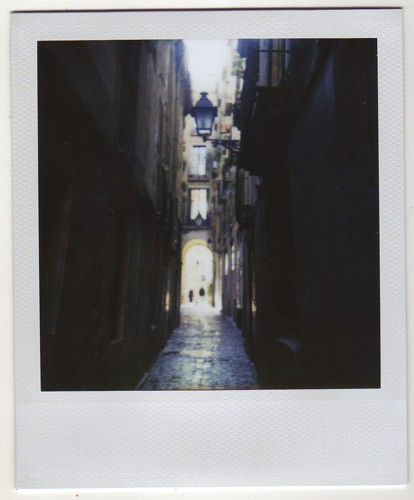 Below Eixample and on the other side of Via Laietana is el Borne. Once upon a time, it was as seedy as el Raval, now it's one of the trendier barrios of Barcelona. The buildings are a mix of old and new, making elevators and space hit or miss, while the neighborhood itself is full of hidden squares and cool little nooks and crannies with a happening nightlife for the posher crowd, but along with it comes the constant street buzz drunks stumbling home, and some petty crime.


 Ask a hundred people what they like best about Barcelona, and you'll probably get a hundred different answers. Personally, I find myself attracted to the doors. Don't ask me why. But maybe a picture now and then will help explain my strange puerta fetish. So today, I present one of my favorite entrances.

 Not as famous as the Barrio Gotico with its labyrinth of tiny alleys and Gothic Cathedral - but for my money - no neighborhood is better to get lost in than Eixample to fully appreciate the beauty of Barcelona.
  The largest of the city's many distinct barrios, its wide streets are lined with buildings that seem more works of art than places to live or work. The most famous of these are the ones built by Gaudi located on Passeig de Gracia, but take a moment to wander off the main streets and escape the crowds, and you'll enter a world of carved stone trees and a couple tenderly looking into each other's eyes.
