Showing posts with label culture. Show all posts

Friday, April 23, 2010

Happy Sant Jordi

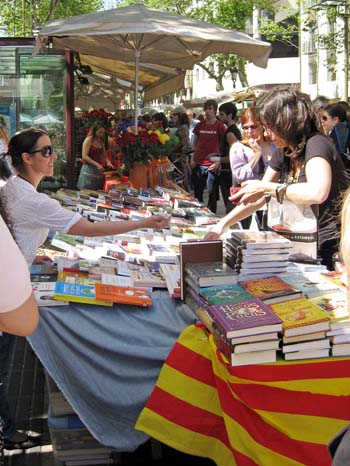
Today is one of my favorite days in Barcelona, la Diada de Sant Jordi, or Saint George's day. Honoring the patron saint of the Catalunya who is famous for slaying the dragon, it's celebrated with the simple gift exchange of a rose for her and a book from him.

Surprisingly, it's not a public holiday, but if you're out and about it seems like it is based on the crowds strolling the streets and looking at the flower and book stands.  And what is truly amazing is that it can rain the day before and it can rain the day after, but no one I know remembers it raining on Sant Jordi. 

So if you're in town, make sure to take in the sights and sounds of one of the more special days here. If you're not, why not buy a rose or a book for a friend to celebrate anyway.  Here is an interpretation of the legend behind the celebration. Enjoy.

Wednesday, April 21, 2010

Barcelona Sights - La Sagrada Familia

No building has come to define Barcelona like La Sagrada Familia. Designed by the city's most famous architect, Antoni Gaudí, it combines neo-Gothic and modernist styles to create a church unlike any I've seen.

Yet, surprisingly, for all of it's acclaim, the church hasn't been without controversy. George Orwell in his book "Homage to Catalonia" said, "I think the Anarchists showed bad taste in not blowing it up when they had the chance," labeling it "one of the most hideous buildings in the world." More recently, Josep Maria Subirachs's minimalist interpretation of the passion façade brought complaints that it didn't adhere to what was left of Gaudí's original designs, most of which were destroyed by the aforementioned anarchists during the Civil War.

Beauty or monstrosity? I personally think the former and never tire of getting the chance to walk by, look up and marvel for a second while meeting a friend or running errands. So if you're visiting, there are some great hotels close to the Sagrada Familia if you want to stay near by and stroll the tree lined Avenguda de Gaudí, which links the church and the famous Hospital del Sant Pau.

Wednesday, March 17, 2010

Barcelona Artist - Agustí Puig

The LA Times ran a glowing article on Barcelona recently where it discussed its storied artistic history and mentioned some contemporary artitists who are maintaining this rich tradition. One such man is Agustí Puig whose work was the inspiration for Penelope Cruz's character in "Vicki Christina Barcelona" and was featured in the movie.

A painter, sculpture and photographer, Puig's stated idol is one of Barcelona's most famous adoptive sons, Pablo Picasso, who came here from Malaga as a teenager and his influence can be seen in the energy of Puig's work. Unfortunately, there aren't any current exhibitions of his in Barcelona with closest one being held at Messum's gallery in London.  So to give you an idea of his style, here are a few pieces of his:

Tuesday, February 23, 2010

The New Religion

I've recently found myself thinking back to my university days when the professor would try to encourage student discussions during one of the numerous poli-sci classes I had to take for my major.  From my freshman to my senior year, whether the subject was about the study of politics as a science or comparative forms of government, the topic of the influence of religion invariably came up at least once or twice a semester.

Religion no longer plays such a prominent roll when it comes to current political debates here in Spain, fortunately. There are a few right-wing, Opus Dei Catholics wanting to ban abortion, but in general, there's none of the heated culture wars like in the states. Gays can get married and I haven't read of anyone trying to teach creationism in biology along with evolution like they did in Texas, thank Jah.

No, here in Spain, it's nationalism, which is essentially a different side of the same ideological coin:  heads, a mythical man; tails, a mythical nation. And like the idea of an all mighty God binds Christians, so does the idea of strong independent state unite nationalists.  After all, no one blindly worships something weak and in both cases, they can cite historical events dating back centuries as the foundation for their beliefs while dismissing or revising parts that conflict with their narrative.
 
But just like religion doesn't hold up to logical scrutiny nor does the concept of a nation make much sense. After all what is it? According to the dictionary, "It's large body of people, associated with a particular territory, which is sufficiently conscious of its unity to seek or to possess a government peculiarly its own." It sounds a bit flexible to me. At least God gets a less ambiguous definition:  "The one Supreme Being, the creator and ruler of the universe." It seems a nation, like a religion, is more an artificial construct of a few men to control the masses rather than a real physical being like a tree or a monkey.

Look at most countries and go back five hundred years; chances are it'll have a different name or be part an ancient kingdom. Once upon a time, there were the Aztecs, the Moors and the Celts. Between then and now a lot has happened: the world was rediscovered to be round, people no longer travel by horse and carriage but by machines that can fly; wars were waged, millions killed and boundaries changed all in the name of a religion or to raise the flag of a nation. The result is the world as it is today nearly half a millennium later. A tragic and a pretty damning indictment of the human species time on earth, I know.

But despite this bloody history, polls show almost all human beings still believe in some form of religion and nationalism, so ingrained is it in our nature. For example, its easier for a Muslim to be elected to the US presidency than  an atheist, just as I imagine a self-anointed Catalan fascist would stand a better chance in local elections than a self-described Spanish socialist.  One reason is human nature; we like to belong and feel a part of something bigger than ourselves and we want our beliefs reflected in our leaders. In most cases, I think, it's a loose loyalty.  People believe in God not because they think he actually created the earth in seven days and made man from his rib, but because faith gives them comfort in a chaotic world.  Likewise, the majority of people support their nation for the camaraderie and pride it gives, rather than seeking to impose it on others through conquest. As with most things in life, done moderately, both religion and nationalism serve a useful purpose.

Within each group, however, there is the passionate minority; I like to call them the foot soldiers for their rulers, the pawns of the kings. Ideologues and evangelicals, they take an absolutist and uncompromising stance and feel the need to spread the word. Like the foundation for their beliefs, they cite historical injustices visited upon the father of the father of the father as the reason for their militancy and insist on fighting past wars instead of facing current problems. They see the world not as it is, but through a lens of persecution and victimization.  Mere mortal men become super villains whose diabolical plans to destroy them must be stopped. Any of us who disagrees with this world view is labeled an extremist, bitter or naive. They are the enlightened ones after all and we are the barbarians who must be converted for our own happiness.

The problem is people who worship mythical ideas don't live in reality. They follow the tenants of their rulers and beliefs unquestionably, while denouncing any dissent as a fantasy or a product of mind control by their perceived enemies. Logic, nuance and perspective don't exist; economic well-being and social harmony must be subservient to the elevation of their ideology above others. It is all about us conforming to their view and the sad truth is the passion of zealots can't be matched which is why, although the minority, they dominate the political discourse by shouting the loudest.  Unfortunately, any cursory study of history will show they're also the reason it's been so bloody. Or as Czech dissident-turned-president Václav Havel once wrote: 'Ideology offers human beings the illusion of dignity and morals while making it easier to part with them.' "

Friday, February 5, 2010

The Ghosts of Barcelona

A big fan of all things supernatural, I've always been a bit surprised at the lack of ghostly legends in Barcelona whenever I ask someone about them given its long and at times violent history. Well, I'm happy to say, there's a new book out that details the various ghouls and specters which have haunted the city.

It's in Catalan and I've got a million things on my plate, so posting about them will be slow going. Still, I just wanted to share the first spooky sighting near the famous fountain on the upper part of Las Ramblas or Font de Canaletes (near the Burger King) where legend has it if you drink from the fountain you are destined to return to the city.

Apparently in the latter half of the nineteen century when the old city wall remained and there was no running water, people reported seeing a specter in a long black cape slowly patrolling the area when the sun went down. One day it spoke to a group of girls who were filling their water jugs, causing them to flee. Tired of this ghostly apparition, the neighbors gathered to confront it, yet it never returned...

If you're interested in purchasing the book, it's available at ETC LLibres in Poblenou.

Wednesday, February 3, 2010

La Chirigota

The next fiesta I believe is Carnaval sometime this month. Sitges is the popular spot locally, but within the peninsula, the celebration in Cádiz has the reputation as the most colorful and the local gaditanos take great pride in this.  Driven by music, singing, and humor it's based around La Chirigota, a group of singing men in costume. It's definitely well-worth a visit if you have the time. Staying in Cádiz , Cádiz, will be next to impossible, but there are the surrounding cities like Puerto Santa Maria and Jerez. Sevilla is also just two hours away by train. Below is an example. Funny people.


Tuesday, February 2, 2010

The Expat Perspective

I often get a kick when I read interviews with expats living in Spain because many cite the climate as one of the factors they enjoy most about the city they live in or the country as a whole. Coming from Southern California where it's in the mid-twenties Celsius and almost always sunny, I tend to find Barcelona a bit on the cold and damp side during the winter and spring, too muggy in the summer, with my favorite season being autumn and in particular October.

What appealed to me about the city wasn't the weather, the beaches or the chance to go skiing driving distance away. I had all that back home. No, what attracted me was its vibrancy and buzzing energy, its beauty and its diversity. I had been to many places in my life before coming here, but none had made such an impact like Barcelona did when I first visited in 2001. And, when two days after returning to the states, I watched the two towers fall, I started wondering what it'd be like to live here as friends of mine started calling for the bombing of all Arabs, labeling anyone who disagreed a traitorous un-American. This, of course, wasn't the sole reason, but let's call it the catalyst and why I immediately crouch into a defensive posture, cover my ears and scream at the first sign of any nationalist hysteria.

During my seven years since, my friends have regained their sanity, while I've done my best to integrate, learn the languages, know the people and listen to their stories. I have a wife whose Catalan father went to Sevilla in the fifties because it was easier to get into med school and married a girl from Cordoba who was one of the first female doctors. My missus considers herself Sevillana-Catalana, but doesn't mind being mistaken for English, and my father-in-law still says arros. We think of our daughter as Spanish-American and named her after a Catalan queen and train station out of respect for the land of her birth and our preferred form of transit. I do my best to speak the languages, although probably not as well as I should because of the amount of time I spend writing in English. Still, I can communicate, understand most TV and tell a joke which ain't bad given my study habits and tin ear.

My perception and attitudes of the city, the politics and its people can't help but be influenced by my background, however. For those who might not know, California has been since its inception a mix of ethnicities, nationalities, and races; the relationship among them has often been volatile and violent, full of exploitation and repression. I can still clearly remember waking up on April 29th, 1992 to the images of my city burning in response to an unjust verdict, an innocent man being beaten with bricks and the six days of rioting that followed, resulting in the marines coming in and fifty-one people dead. Of course, this ethnic unrest wasn't an isolated incident for Los Angeles or the country, nor did it signal the end of the deep and complex causes behind it.

What it did do, though, was change the rhetoric. The local leaders of the various ethnic communities realized, as they observed the charred aftermath, stoking the flames of division to complicated problems led to the same destructive end. Now, is Los Angeles a mecca of racial and ethnic harmony? No, but compared to where it was twenty years ago, it's like a completely different city. You can go out on Venice Beach and Hollywood Boulevard at night now and not worry about getting jumped or shot because of your race or ethnicity. And I guess it's surprising to me that in Europe and in Spain, where the last century it was wars, not riots, people still insist on repeating the same mistakes. As Marx said, "History always repeats itself twice: first time as tragedy, second farce." I often wonder which time it is now.

I think coming from California has clouded my whole concept on who is what, honestly. My  grandmother's Mexican neighbor recently got her U.S. citizenship at age fifty by taking the national exam in Spanish, while my British uncle refuses to become an official American even though he's lived there forty years and has just the slightest hint of his London accent. There are areas where all the signs and conversations are in a foreign language and many of my friends are of different colors and nationalities with US passports who'll bet against the states in international competitions. Whatever tongue you speak is peppered with foreign words and no one corrects. People are free to pick and chose who and what they are. Identity is a personal choice and not a governmental decree.

In many ways, Barcelona, and Spain in general, is a more open and tolerant society than Los Angeles and the U.S.. I've found the Catalan and Spanish people to be less judgmental and more grounded; the ability to live how you want is less inhibited and the sense of community is stronger. The exception, it seems, is when it comes to the decision of personal identity, at which point the local government must step in and clarify the situation followed by a thorough education explaining why you are what you no questions asked, please.

I'm not trying to say Los Angeles and California is the perfect example, but it does offer a real world model because it's a multilingual, national and ethnic society with deep, historical divisions and despite that there is no official language; there is no program of assimilation by imposing one culture on the other or majority-minority language arguments by sensible people. You speak depending on the need whether it be English, Spanish or Chinese and we don't spend hours on the details of the language. There are even pilot programs (here, here) allowing choice at the community level, including the indigenous Navajo, along with traditional standards like French, or the possibility of Mandarin or Cantonese. These are still in the infancy and whether they can withstand the budget crisis remains to be seen, but it's refreshing to see the topic researched and addressed in an inclusive way and not by applying a different language to the previous failed system. I suppose that's what happens when ex-hippies work in education and not political linguistic doctorates.

I guess what saddens me most is that one of the things I loved about Barcelona when I first came was its diversity; yet it's rarely celebrated or embraced publicly.  It's probably why I feel so passionately about it, but I shouldn't since it's not my country and I can always leave. Of course, it's not all that bad, especially if you don't read the news and treat it like religion and politics in the states, quickly changing the subject at first mention. But it's tough sometimes because those topics and languages are what Spanish, Catalans and expats like to talk about. In fact, in Europe as a whole I've found. And why not? They're fascinating subjects. But what invariably happens is because of different backgrounds and perspectives it's sometimes like a conversation between a duck and a rooster even if you're using the same language.

Friday, January 29, 2010

Language is a Fickle Bitch


Catalan company, Spanish packaging.  Advertised today on Canal Vuit during Arucitys as "typical Spanish rice from Catalunya." Love the contact info.

Dirección y contactoDirección y contacto
Gran Capità, 34
Localidad: Amposta
Código postal: 43870
Región: Catalunya
País: España
Teléfono: 977702954
Email: info@museumontsia.org

Tuesday, January 26, 2010

Three Cheers For The Elderly!

As some of the recent comments on "the drinking and smoking..." post show, one of the more pleasant surprises newcomers to Spain have is how active the elderly population is here. You can see them shuffling around, pushing their carritos from fruit stand to supermarket as they do their own shopping. On sunny days they gather on benches under trees with their friends, their lap dogs sitting close by and chat, punctuating their sentences with laughs. During the evening, you'll find them at the local bar sitting around a table talking loudly and animated about their family and friends while stroking the fur on their pet Yorkshire terrier that sits on their lap. In fact, if you were to judge a country solely on the how active the people are in relationship to their age, Spain would be near the top I imagine. So with that in mind here are some of my five favorite characteristics of la tercera edad.

1. They never sweat. It can be the middle of August. The sun is blazing and the humidity sticks to the skin, yet there they are, dressed in skirts and blouses, stockings and shoes, their madeup faces free of one bead of sweat as they cool themselves by waving a fan just under the chin.

2.  They dress with dignity.  Compared to the rest of Spain, I think Barcelona is a bit more on the casual side fashion-wise but you'll never find an elderly person here going out in sweats. From their dyed hair to the wrinkle free clothes they wear, everything is immaculate and well-put together with an understated class.

3. They provide a glimpse into Spain's past. This holds true for most senior citizens I find no matter where they live (not for Spain, but the country they're from), but there's nothing more interesting that sitting down and having a chat with an elderly neighbor. They'll be more than happy to share for a few moments company and it's amazing what you'll discover. 

4. They're out and about. A friend of mine's father likes getting up at the crack of dawn and going out to get each of the free newspapers before they're gone so he'll have something to read. Every week day this is his ritual while at five o´clock rain or shine I know I'll see the elderly couple from across the hall walking the neighborhood's streets arm-in-arm for their daily paseito. Like I said, they just seem more active.

5. They're friendlier. Whenever I go shopping at the market, I can usually count on one senior citizen offering me suggestions as to the best cut of meat or a new cheese to try. Nowadays, it often corresponds with what I planned on buying anyway, but it's always nice to hear some friendly advice. And I remember when I first came here and didn't speak any Spanish getting a real hoot from the old guy trying to explain what the shop keeper said to me by shouting different words but using the same language and speed as if the problem was my hearing. It was all very surreal.

Tuesday, January 19, 2010

Final Thoughts On Catalan Independence

One of my new year's resolutions was to avoid posting on any issue related to Catalunya vis-a-vis Spain and the politics of the relationship, but a recent article in the Economist and some comments from a local author about my book made me decide to rant one last time before resuming the resolution for the Chinese new year.

First of all, a little perspective. It is only in Barcelona and Catalunya that anyone really cares. In a lot of ways, it's like the entertainment industry in LA, political gossip in DC; it's a topic that you'll only ever discuss if you live here because of the disproportionate importance given to it by the media compared to what truly concerns most people (jobs, economy, environment etc). Of course, there is a difference. In Los Angeles, it's about which director is about to get the next blockbuster and in DC it's about which politician is a drunk, while here it's about the tricky and emotional question of national identity.

In fact, many of the aforementioned author's objections to the stories were in regards to how I dealt with this issue and whether Spanish or Catalan was the appropriate adjective to use to describe the people from Barcelona.  According to him, there was a consensus reached in the the mid-nineties that anyone born in Catalunya was Catalan first, unless they said otherwise and regardless of the language spoken at home. They could be just Catalan, or Catalan plus something, but first and foremost Catalan. That very well may be the case, but international consensus and law, for many decades, has used the country on the passport or ID card to describe somebody's nationality, thus making the people from Barcelona, Spanish, in the eyes of most of the world and the intended audience of the book. That's the reality of the situation.Besides, on a practical level, how the hell can you tell if someone was born in Barcelona and not in Zaragoza or decide if that group at the table is Spanish and Catalan, simply Catalan or just Spanish? Should one just assume everyone walking the was born here and thus Catalan? That's a bit disrespectful to the millions of Spaniards who live and work in the city, isn't it?

As a fiction writer, the question of Catalan or Spanish often comes down to how best to describe a character and has little to do with local semantic arguments about what constitutes a nationality. For example, the quintessential Spanish beauty, what do you imagine after reading that? A dark haired, dark eyed, brown skin girl, right?  If I were to write the quintessential Catalan beauty, I'd have to use different adjectives: paler skin, larger eyes, blonder hair. I suppose I could replace Spanish with Catalan for the sake of being politically correct (there are many local women who have dark traits), but I would have to remove the word quintessential and add her beauty was due to her Spanish blood or something along that line. It really does seem a petty point to critique but that's the state of the debate of identity politics here it appears.

When I first arrived in Barcelona, my mind and opinions were blank and open when it came to this issue. Politically, socially, economically, I lean left and fully support people's right to self-determination and governance. After seven years of living here, having had literally thousands of conversations with hundreds of people about this topic almost to the point of ad nauseum, I have little sympathy for the nationalist cause or the people who state Catalunya is an occupied territory. Truth-be-told, I find such statements and the arguments in favor of independence lacking in any basis of reality and sometimes tinged with an element of racism.

What do I mean? The vast majority of Catalans I've met, whether their family has been here for generations or their parents came from somewhere else in Spain during the forties and fifties, have little problem speaking Spanish or feeling part of the country. They support the national team, talk fondly about their last trip somewhere in Spain and complain about the ineptness of the national government. They feel both Catalan and Spanish and see no contradiction being both nor do they see one as better than the other. Unfortunately, while the majority, they aren't the ones driving the debate.

From my experience, it seems many of the most vocal and ardent nationalists are people who were born here but with Spanish parents. Claiming to be Catalan and only Catalan, they will renounce all things Spain, sometimes going so far to say they hate the country, while speaking of Catalunya's superiority in terms of culture, demeanor and work habits. I suppose this overcompensation is normal and a psychologist would attribute it to a deep seated insecurity of said people to fit in. Still, coming from the states where citizens celebrate their Irish connection 300 years after their ancestors arrived, I have a hard time fathoming how someone can speak so poorly about the land of their parents, grandparents and great-grandparents. As a father of a baby girl, I wonder what they're teaching in the schools to make people feel such a way towards their ancestry and if I want my daughter to attend classes here.

True, this is only a small element of the people arguing for separation with most proponents using economics to push for the cause. Some will say, if only we were a republic like the United States to which I reply, you have no clue what you're talking about. The largest state in terms of economy is California. If it were a stand alone country, it would, I think, be the seventh or eighth biggest economy in the world, larger than Spain and perhaps Italy. Yet, the state is an absolute mess financially, on par with Greece, and it receives little of the federal income tax revenue it generates which would help the situation; the money used to run state services raised through local taxes which are the highest in the nation. And what about the millions of federal tax dollars the state contributes? It's managed by a senator in charge of the appropriations committee from a much less populous state who uses it to fund a bridge to nowhere for his constituents, thereby ensuring his re-election. In political jargon it's called "pork" and as a person who has lived both in Spain and in the states, I'm telling you - you've got less of it and more financial control as an autonomy than you would as a state so don't wish for a political system you don't understand.

The most common number cited, however, is 25/15; the amount the region gives to the national economy compared to the percentage it receives back. How unfair, people will scream, neglecting to point out that Spain, and yes Catalunya, has received a far greater amount of revenue from the European Union (namely France and Germany) than they've put in. How one economic model is fine on a European level but not on national one strikes me as a hypocritical, but leaving that alone, I do have a question - What did the regional government do with this money from Europe? Did they use it to reform some of the systematic problems which was the implied agreement? Did they use it to build a different economic model truly separating Catalunya from Spain? No, like the national government, they used it to fund the construction boom that saw the price of housing skyrocket while salaries for the citizens stagnated, resulting in the current mess we're in. And you want these men to run your country?

If you read the comments to the Economist article, you'll see many pro-independence voices claiming the region would be better off without Spain, although they offer no statistics, numbers or even logical conclusions to back up their assertions, only blanket statements. But is it true? Well, they'd gain complete control of tax revenue and end the net ten percent loss of the current system, but they'd also face higher expenditures and pay €937-€1024 more per capita into the EU budget than it would receive (see comments below). Assuming complete responsibility for  ALL services (unemployment, pensions, health, transport, police, etc) isn't cheap, not when there's an aging population, low fertility rates and high unemployment like here. Add GDP shrinking at a slightly higher percentage than Spain as a whole and a growing current account deficit to the equation, and I don't think it's far fetched to predict a wash at best, maybe even a net loss.

The economic problems facing the region (such as the need to lower wages to reduce the costs of goods produced here, but being unable to devalue the currency due to being in the Euro zone) wouldn't go away as a result of separation. After all, I assume an independent Catalan state would use the euro and not introduce its own currency. In other words, even if it were a stand alone country right now, it's economy would be just like Spain's, unless the politicians could convince the citizens to work for less in exchange for independence and that ain't happening. Thinking about it, I'm not sure an independent Catalan state as it stands now would be granted admittance to Europe considering how little appetite the EU probably has to include one more member in the PIIGS (Portugal, Italy, Ireland, Greece, Spain) block that might need a bailout, especially since the area doesn't offer cheap labor to German factories like Eastern European nations nor is it an exporter of highly-sought after goods. I take that back; there's cava.

But what of those local tax revenues generated which would be used to justify inclusion in the EU and Catalunya's independent status? When I look around the city I don't see an explosion of local, Catalan, businesses. Like the rest of Spain, I see a place beholden to foreign companies, construction and tourism for much of its employment. And just out of curiosity, where do people think a multinational would put its headquarters for the Iberian peninsula if Catalunya became an independent country with its own language? Would some CEO sitting in New York, London or Paris be willing to pay additional expenses to have all communication first done in Catalan and also in Spanish? Just look at how Portugal fits into the Iberian corporate model of many multinationals to find the answers to those questions. Basically, what I'm saying is - there's no guarantee the region could sustain its current income level as an independent state but there is a possibility it could see a decline and that doesn't even take into account the probable brain drain as Spaniards (i.e. those not from Catalunya) decide perhaps Madrid or Valencia is a better option since they can feel free to speak their native tongue there. Ditto for the thousands of Latin and South American immigrants living here.


I don't mean to come across as anti-Catalan or against the right for someone to identify themselves as such. I think previous posts will show I have a tremendous amount of affinity and respect for the people here. You can feel anyway you want and I appreciate that. I personally don't feel very American having lived most of my life outside the US, but it doesn't change the fact that's what I am in the eyes of everyone who meets me, just as it doesn't change the fact that you are Spanish even if you were born in Barcelona to most of the world.  Now you can get angry and tell me how wrong I am with that statement but it's the truth and to say otherwise is to deny reality. Of course, the healthy thing to do is not waste time debating if you're a nation or not but fix the systematic problems of the region, laying the groundwork for a free Catalunya, making the point moot, but that requires doing something other than pontificating and blaming Madrid. It means serious, objective analysis and hard choices. Also, as the saying goes and the evidence shows - be careful what you wish for; it probably won't be the elixir you expect.

Anyway, I've said my peace and I promise to leave it at that.  If you have any problems with the points I've made, feel free to say so and if you want to counter them fine, but show me you've thought about it and explain why I'm wrong; don't just tell me or spout some party line. It really is a tiresome issue and one that I think prevents the Spanish people, whether they were born in Barcelona or Oviedo, from uniting to right this country by exaggerating the few differences while downplaying the many more similarities, which is why the next post will be on something almost all Spaniards agree on: namely, the deliciousness of jamon iberico.
Saturday, December 19, 2009

Tuesday, December 15, 2009

Mix-Mash Navidad

The arrival of a baby this year has added something special to the holiday season, although she's still too young to know who Santa Claus or the Magic Kings are and prefers boxes to toys. Still, it's never too early to revive old traditions and start new ones drawing on customs from her two nationalities (Spanish and American).

As I mentioned in a previous post, the holiday season here lasts a month and the main gift-giving day has traditionally been el Dia de Los Reyes Magos in January. In general, I've found the whole approach to presents quite different between Spain and the states. I remember back home feeling an intense pressure to buy and build the pile under the tree, rushing from store to store in a packed mall in a desperate search to find something for someone who seems to have everything.

Here, the number of presents tends to be singular maxing out at three or four. They are generally lower in monetary value, but more personal in nature, speaking to the recipient's personality rather than the latest it item according to all the magazines. The Spanish call it un detalle. Meanwhile, many shops are located in the old medieval part of the city whose tiny squares are full of merchant tents selling arts, crafts and food and whose stone churches might be housing a string quartet playing Bach.  It almost makes shopping and the crowds bearable.

I am glad, though, that the kid will be able to spend every other Christmas in the states. There's something infectious about the tacky decorations, catchy carols and bright lights. The holiday season there seems to be more festive than it is here. Perhaps its because of Catholicism and the fact that Christmas is first a religious ceremony, but the Spanish seem to be more restrained and somber in their celebrations that us enthusiastic Americans.

As a kid, the picking and decorating of the tree was what I enjoyed most about Christmas (after the presents of course!) One family tradition was buying a new ornament each year from somewhere off the beaten path and when I look at the tree now, it's so full of memories. It's definitely something I'm looking forward to sharing with the kid. Of course, my wife as equally fond memories of building the belén, or nativity scene, and placing the various figurines around the manger so that will definitely be something for us to do and I can't wait to visit the Christmas markets and have our daughter pick out her first Jesus, Mary and caganer. And since we live in Catalunya, she'll also have the caga tio adding a new tradition to the season.

When I think of Christmas, the first name that comes to mind is Santa Claus but he plays second fiddle to the Three Kings in Spain. Reconciling when to give presents, Christmas or King's day, isn't much of an issue anymore, however.  More and more Spanish parents are spreading out the gift-giving so their children will have something to play with over the holiday break and I imagine we'll do the same. Still, I am looking forward to putting this growing belly and white hair to use and donning the red suit on Christams Eve, shouting ho, ho, ho. I also promise to try not to be one of those bullish parents on the night of January 5th when the Kings parade through the city who knocks over granny for that piece of candy.

The one area that's impossible to find compromise is the food. My Spanish in-laws prefer fish, lobster and jamon iberico for Christmas dinner while my family back in the states sticks to the turkey, honey glazed ham and yams. Neither are adventurous enough to add new items to their menus. So far so good, the baby's not picky when it comes to food nor are her parents. The one tradition that we are able to introduce this year here, however, is Christmas crackers which comes from neither America nor Spain but England thanks to her paternal grandfather's side of the family.

Monday, November 23, 2009

The Golden Witch and the Town of Luck


If you walk into a tobacco shop or anywhere that sells Christmas lottery tickets, you're liable to see a witch riding on a broomstick hanging from the ceiling, or a sign with her picture on it. Called La Bruixa d'Or or La Bruja de Oro or the Golden Witch, she hails from a small town called Sort (luck in Catalan) in Lleida and is famous enough to warrant its own Facebook page.

The brainchild of an enterprising Spaniard, Xavier Gabriel, a lottery ticket vendor in this small rural town about three hours east of Barcelona has transformed itself into the number one place to buy tickets for el gordo (the fat one) the national lottery that takes place on December 22nd with enough pomp to rival the Eurovision final. The lottery itself is famous for going against the grain and spreading the prize money rather than give the whole lump sum to one person and the town of Sort is home to the most winning numbers in Spain. Perhaps, there is something to a name or maybe it's just that more people buying from one location immediately increases the probability or it might even be as Xavier Gabriel says, a golden witch from outer space who sprinkles lucky dust. Who knows. But if you want to partake, here's the link to the official page.

Friday, November 13, 2009

Favorite Spanish Dish

When most people think of Spanish food, they think of paella or jamon ibereico. My personal favorite dish is huevos fritos con patatas fritas. Normally it's topped with a slice of lightly grilled jamon and there's something about the way the runny yoke softens the fried potato, as the salt tickles the taste buds that makes each bite easy and fulfilling, making it the perfect dish after a heavy night out.

Monday, November 9, 2009

Book - My Christina & Other Stories

For anyone interested in Catalan literature a good place to start is with My Christina and Other Stories (The Graywolf Short Fiction Series)A female writer who first came to prominence here during the first part of the twentieth century, she fled Barcelona following the civil war and settled in Geneva until the death of Franco. 

The collection is a series of seventeen short stories written predominately in a monologue style that characterizes her work and ranges from slice of life tales to ones that are more surrealist in nature (a witch who turns into a salamander for example), with most containing a wry humor common in these parts. Unlike the more well-know Zafón, they don't so much describe what Barcelona was like aesthetically in those times, but they do provide a glimpse into the life here through rich characters and a keen sense of observation.

Friday, September 25, 2009

What is a Catalan?

As the number of comments an article about the history of Catalunya shows, the topic of national identity in Spain is complicated and emotional, provoking intense feelings on both side of the debate.  This, of course, makes discussing it difficult and compelling because somebody's bound to get angry when passions become inflamed.  So, what better topic on which to write, right?

Like with most of the nationalistic debates taking place in Europe, this one traces its origins back to the middle ages, when the continent was a mix of small kingdoms and principalities battling it out for resources and land. The proceeding centuries saw many of these independent countries annexed by the rising European powers of the time (namely France, England and Spain) as they set out on their colonial conquest.  But, unlike say Ireland and Scotland that became part of Britain through invasion and brutal force, the King of Aragón (and Catalunya) married the Queen of Castilla, uniting the two nations under the Spanish flag, which for the times could be considered a peaceful consolidation of power.

Initially, the region was free to speak their native language and practice their traditions.  As with Castellano, Catalan was rooted in Latin, but because the Moors had failed to conquer the region, it had none of the Arabic influence, making it sound like a mix of Italian and French.  This freedom was short lived period, however; and over the course of the ensuing centuries, the ability to speak the language in public came and went with varying degrees of violent repression, depending on the king or dictator.  Today, it's the co-official language, taught in every school, and the first basis of the Catalan identity, which means it survived the times better than Gaelic, and so ends this history lesson. 

Personally, I like the sound and trying to speak it.  There's something about the words, intonation and pronunciation that brings out a real warmth, if that makes sense.  And, because the words are shorter and it has the "jay" sound, it can be easier than Spanish.  Yet, while it is undoubtedly a different language with its own grammar and vocabulary, I can't help but hear some similarities to Castellano.  I don't mean in words and sentences, but how it's spoken - loudly and abruptly with every third word a curse.  Although, given the Catalans' scatological sense of humor, they tend to be about shit and ass rather than female and male genitalia.

Aside from the language, the second biggest difference Catalans will point to is their personality.  Unlike the rest of Spain where work is a necessary evil, they embrace their jobs and put in a full day.  And, it's true - I've never met people who spend so much time at the office and are proud of it.  Whether or not they're more productive is another question entirely, and I often wonder if they've heard of the law of diminishing returns.  In fact, I sometimes tell my Catalan friends and students - if they really wanted to be different than the Spanish - they'd not work ten hour days, but be punctual and plan.  To which they respond: "But we're Latin.  We improvise."

The difference in personality extends beyond work ethic.  The Catalans, in general, take on a more serious and closed demeanor compared to their fun loving and warm Castilian neighbors.  Many visitors comment on the sour faces of the people living here and I can't argue.  They're a stressed lot given all the hours they work.  But I will say, once you've made a Catalan friend, you've got one for life, which hasn't always been the case in other places I've lived in Spain and the reason for the common expression: "Si te he visto, no me acuerdo." (If I've seen you, I don't remember).  Still, even this applies to a minuscule minority of the people I've met over my travels, making both Catalans and Castellanos some of the sincerest and most hospitable people I've ever known.

Now, if you talk to other Spaniards, you'll hear many of the stereotypes associated with Jews applied to the Catalans - that they're tight with their money and insular, which is true and makes sense since the region once had a large Jewish population before the Spanish inquisition made everyone a Catholic and a lover of ham. And, compared to the rest of Spain, where bull-fighting is still celebrated, the fact that it's shunned here and left for the odd tourist speaks less about difference than progress, I think.

But just like the Andaluces, Vascos, Gallegos and Madrileños, the Catalans share a love of eating and dancing that can be found throughout the Iberian peninsula.  The traditional meal consists of sliced blood sausages, cured cheeses and toasted bread with tomato, oil and garlic that takes three hours to eat.  The local dance is called sardanas, which is like a slow motion square dance with a brass band.  Granted, it's not as boisterous as a caseta during la feria, but sometimes a smile on a stoic face says more than a bellowing laugh in a room full of clowns.  And, just like in every other autonomy, they love their local parties and celebrations with special times reserved for family and friends.

Basically, while there are no doubt differences between Catalans and the other regions of Spain, so are there between a New Yorker and an Angeleno, a Manc and a Londoner, a Dubliner and whatever they call someone from Cork (A screw?).  The principal difference with these analogies being that the Catalans are a people who have a centuries old language and traditions, but whose long common history with Spain gives them a shared culture, boasting such artists as Picasso, Dalí and Goya to name a few, and a style of life that still attracts the romantics.  Sadly, in a media and political environment that feeds on conflict, these ties and similarities are often drowned out by the vocal few  longing for an independence lost seven hundred years ago.  And, to them I say - Go ask a Sardinian what they think it was like to be ruled by some distant king from Barcelona back then.

Thursday, September 3, 2009

Neighborhood Festivals - Poblenou


Ver mapa más grande

One of the joys of summer in Barcelona are the neighborhood festivals.  Each barrio has one and they usually last a week with live music, food and local traditions.

The most popular and famous is in Gracia when the entire neighborhood is decorated with paper mache figurines and floats, making it feel a bit like Alice in Wonderland if it had been set in a city.  More infamous and - let's say twisted - is la festa major of Poble Sec where you might catch a DJ dressed in his underwear or see a tranny on a piano showing off the latest surgery at night, while gigantic paper mache statues of people or human castles can been seen during the day.   And, while both of these have come and gone - there's still on left for those of you who have just arrived in Barcelona - la festa major de Poblenou. (thx Linda for the link)

Starting on Sept 12h and running until the 20th, it offers a little bit of everything from games for kids to concerts featuring different styles from ska to Catalan Rumba while the final night ends literally with a bang thanks to fireworks at the beach.  At the top of this post if a map, showing where it is for anyone interested in visiting.  And if I have time, I'll translate the official page of events into English to give you some of the highlights.

Wednesday, September 2, 2009

Twittering Barcelona

Twitter.  It seems everyone is doing it: politicians, sports figures and normal joes.  Pick up an English paper or visit a website, and your bound to find some article about the new Facebook as it's been called, or a link to the corresponding twitter account. At least it seems everywhere except Spain.

When I talk to my Spanish friends or students and ask them about the twitter revolution, most offer a blank stare and shrug their shoulders.  They haven't a clue what it is.  When I tell them, it's a site where people inform the world what they're doing in 140 words or less, their expressions change to a bemused curiosity.  "People sit in front of a computer all day and tell strangers what they're doing?  Why not go to a bar and chat with someone who cares?" they'll say, which is tough logic to argue with.

In many ways the whole concept of social networking and e-commerce is as foreign to a Spaniard as automatic cars.  They know it exists and they might know a few people who do it, but in general, it's not something that's common.  Now, before I get a deluge of comments saying I'm depicting Spain as a backwards country from the twentieth century, that's not the point I'm trying to make.  I have Spanish friends on Facebook and they update their profiles, but not nearly with the frequency or proficiency of my English and American friends, who can put up five to six posts a day.  As for Twitter, I know not one person.

Most of the reason is cultural, rather than lack of Internet savvy, I think.  Spanish people are a sociable lot who like face-to-face interaction and spending days outside.  Sitting at home in front of a computer and typing away to some stranger is like an Englishman going to a pub and drinking non-alcoholic beer - it goes against who they are as a people.  Same thing goes for online shopping, where the purpose isn't just to buy something, but see it, feel it, ask 100 questions about it, and then get together with friends and/or family and have a coffee or lunch.  As for summarizing something in 140 words or less, Spaniards would have trouble with a 500 word limit given their propensity to talk and explain, which isn't a criticism, just an observation.  And if you don't believe me: ask a Spaniard how their day was and time how long it takes them to finish - you'll be lucky if it's under five minutes.

Personally, I find getting out and talking to people on the street refreshing, and this is from someone with borderline antisocial disorder.  Perhaps it's the romantic in me, but we seem to be losing the sense of community that we once had when we know someone in another country better than our neighbor.  As for anyone with twitter.  You can follow this blog: @frombarcelona1

Monday, July 20, 2009

La Tele en Español - Updated

Watching television in Barcelona is an experience in and of itself.  First, there's the question of scheduling.  Many times, what appears in the T.V. guide doesn't match what's actually on the  television, or programs will start ten minutes before or after their official start times.  This of course makes planning when to sit down and veg out a little problematic and requires a certain amount of flexibility about shows you're willing to watch, so be warned.

Speaking of shows, the most popular ones tend to be U.S. series like CSI, Lost, and Desperate Housewives on Spanish T.V.; while on the Catalan channels, there seems to be an affinity for eighties English comedy like Black Adder, Alo, Alo and the Young Ones. They are all dubbed, meaning you'll have to speak Spanish or Catalan to understand.  And, sometimes they'll change a character's history like Manuel from Fawlty Towers, who is from Mexico and not from Barcelona as in the original version, which sheds some insight on the Catalan personality and their sense of humor.

As for actual Spanish series?   Most dramas are basically popular US shows (like ER) set in Spain (Hospital Central), while the comedies all seem to center around a bar.  That said: there are two with a paranormal twist Hay Alguien Ahi and El Internado that seem to combine a little of the Ring with Medium, but are still fun to watch, and better than Buffy.

Daytime TV, meanwhile, usually consists of shows with an attractive female host and a panel of Spanish celebrity watchers.  For at least two hours, they will discuss the latest of both the world-famous like Brangelina and the less so, such as Julían Muñoz and Isabel Pantoja who are the ex-mayor of Marbella and a convicted convict and his Flamenco signer girlfriend, or is it his ex now?  It's difficult to keep up with all the twists and turns that include suitcases full of money and pet tigers.  Also, sure to be mentioned is the ugliest woman I have ever seen: La Duquesa de Alba (pictured).  Why she is so famous?  Because her family owns more land than the king of Spain, proving you don't have to be a Hilton or pretty to buy celebrity - just super rich.

Both public and private channels have commercials which can last from thirty seconds to twenty-minutes with the time growing longer as the show progresses.  Why so long?  I think they figure it will give people time to do things like cook dinner or hang the laundry.  Of course, then people won't see the ads playing which might explain why they're so much louder than the actual shows. 

Movies, like I imagine in most places, are popular with most coming from good ol' Hollywood.  Be sure to tune in five minutes before to hear a person explain what the movie is about, why it's worth watching and a general overview of the plot.  This is also true at cinemas where all the information is provided on a pamphlet prior to viewing.  The desire to know things beforehand isn't exclusive to movies, however.  A big game-show fan?  You'll know before the program if there's a big winner as it'll be announced on the evening news.  All of this makes me wonder if there's a Spanish word for spoiler?

Finally, the influence of the states can't only be seen in the popularity of its shows and movies, even the nightly news is not exempt.  The fastest rising star is a sports caster with a pretty face named Sara Carbonero (pictured) and the use of flashy graphics in lieu of substance is becoming the norm.

Then again, if you're living in the third happiest city in the world, why sit at home and watch T.V.?

Tuesday, June 23, 2009

Happy Saint John

Tomorrow is Sant Joan in Catalunya and San Juan in the rest of Spain.  A national holiday it marks the start of the summer season and tonight the streets will be full of people partying and migrating to the beach in celebration.  Along the way kids will be trowing firecrackers and impromtu bonfires will be blazing in intersentions, while groups of men and women will be running around with sparklers and setting fire to piles of wood.  It's truly amazing the city doesn't burn down, but I guess that's what come from centuries of practice.  If going out, I recommend wearing long sleeve shirts and pants with shoes and not flip-flops to avoid and stray sparks from leaving a nasty mark.